

Conference on “Integration of the Rural and Forest Environment” held on 12 February 2026
The increasing interrelation between rural areas and forest spaces requires an integrated legal, economic, and technical approach capable of effectively addressing current challenges related to sustainability, productivity, and territorial cohesion. In this context, the conference “Integration of the Rural and Forest Environment” highlighted the need to move towards joint management models, in which digitalisation, associative structures, and public policies—particularly the Common Agricultural Policy (CAP)—play a key role.
The comparative analysis of different European experiences has shown the importance of integrating agricultural and forestry policies, promoting regulatory solutions that support forest multifunctionality, cooperation among landowners, and the optimisation of natural resource use. The relevance of financial instruments and public support measures aimed at afforestation was also examined, as well as the growing role of complementary activities—such as beekeeping—in enhancing the value of forest areas.
Overall, the conference provided a space for reflection on the convergence between agriculture and forestry, emphasising the need for more coordinated regulation to foster balanced, innovative, and sustainable rural development.
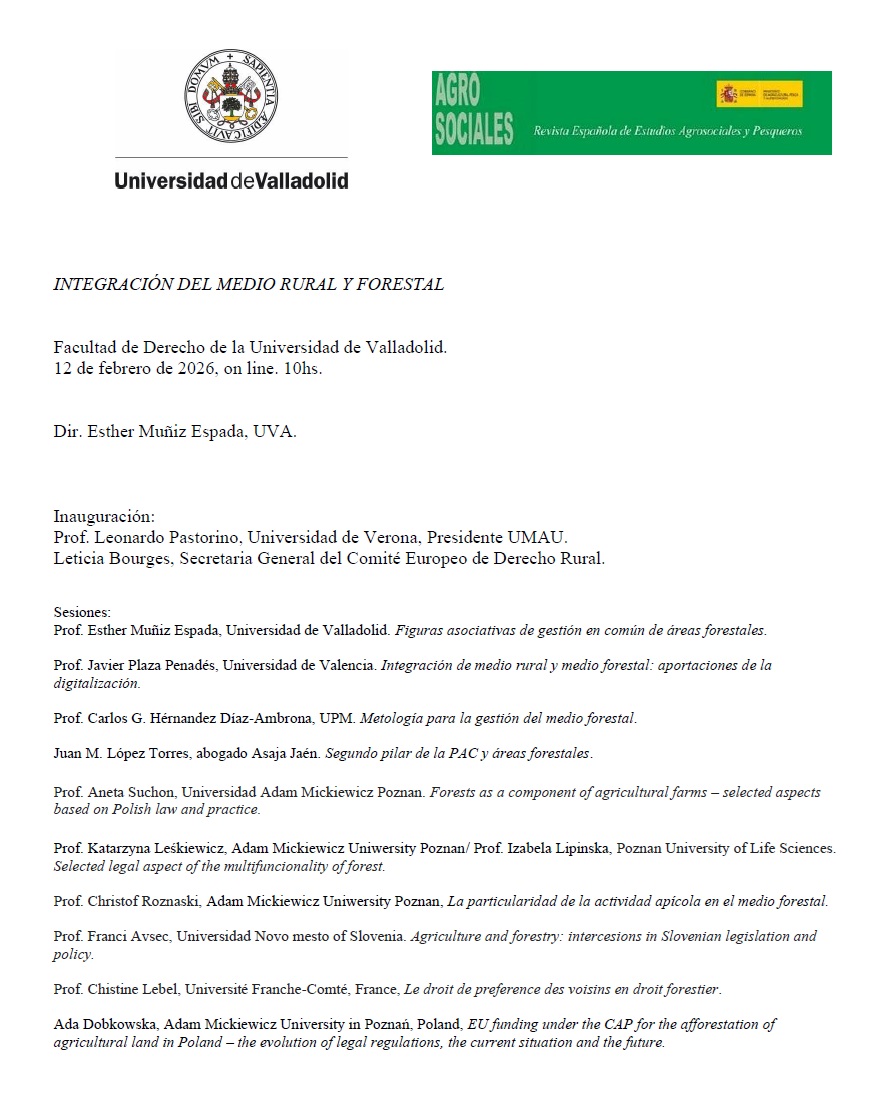
ConferenceThe Faculty of Law of the University of Valladolid hosted, on 12 February 2026, an online conference on “Integration of the Rural and Forest Environment”, directed by Esther Muñiz Espada. The event brought together experts from various European universities to analyse the links between the agricultural and forest sectors from a legal and multidisciplinary perspective.
The opening session featured Leonardo Pastorino (University of Verona and President of UMAU) and Leticia Bourges (Secretary General of the European Council for Rural Law), who underscored the need to strengthen international cooperation in the field of rural and forest regulation.
Key Contributions-
Esther Muñiz Espada (University of Valladolid): Analysed associative structures for the joint management of forest areas, highlighting their importance in overcoming land fragmentation and improving management efficiency.
-
Javier Plaza Penadés (University of Valencia): Addressed the role of digitalisation in the integration of rural and forest environments, emphasising its potential to improve planning and sustainable management.
-
Carlos G. Hernández Díaz-Ambrona (UPM): Presented methodologies for forest management aimed at optimising resource use and ensuring sustainability.
-
Juan M. López Torres (ASAJA Jaén): Examined the second pillar of the CAP in relation to forest areas, focusing on funding opportunities and the role of these policies in rural development.
-
Aneta Suchoń (Adam Mickiewicz University, Poznań): Analysed forests as a component of agricultural holdings, based on Polish law and practice.
-
Katarzyna Leśkiewicz and Izabela Lipińska (Poznań Universities): Explored legal aspects of forest multifunctionality, emphasising its economic, environmental, and social dimensions.
-
Krzysztof Różański (Adam Mickiewicz University): Discussed the specific nature of beekeeping activities in forest environments as an example of sustainable use.
-
Franci Avsec (University of Novo Mesto, Slovenia): Analysed the interactions between agriculture and forestry in Slovenian legislation and policy, highlighting coordination challenges.
-
Christine Lebel (Université Franche-Comté, France): Explained the right of pre-emption of neighbouring landowners in forest law as a useful tool for land organisation.
-
Ada Dobkowska (Adam Mickiewicz University, Poland): Analysed EU funding under the CAP for afforestation of agricultural land, assessing its evolution, current situation, and future prospects.
The conference concluded by stressing the need to move towards a genuine integration of rural and forest environments, supported by effective legal instruments, cooperation among stakeholders, and the opportunities provided by the CAP. It also highlighted the role of innovation, digitalisation, and forest multifunctionality as key pillars for ensuring the sustainability and competitiveness of the sector in Europe.