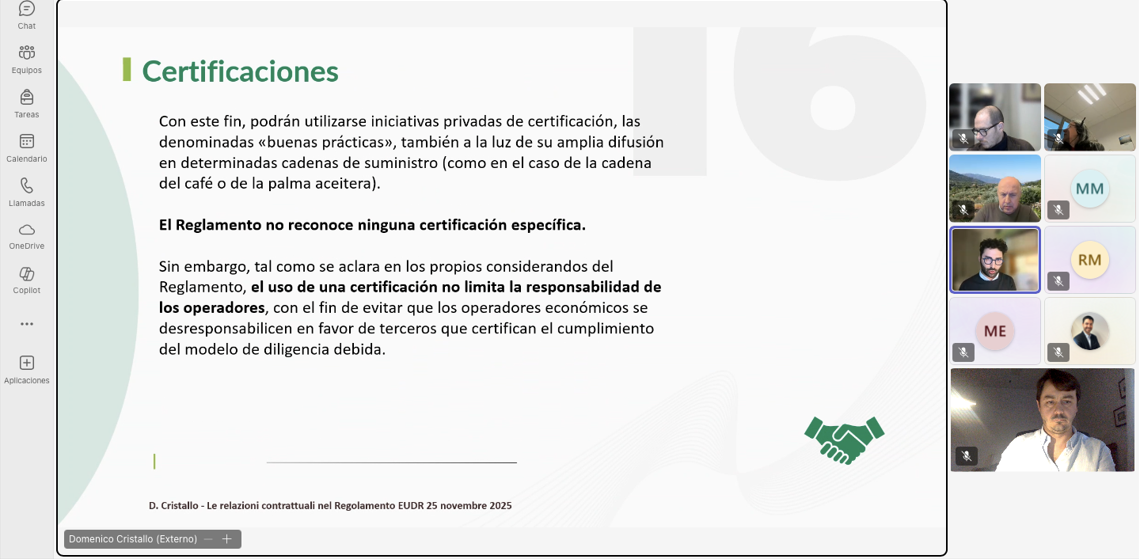
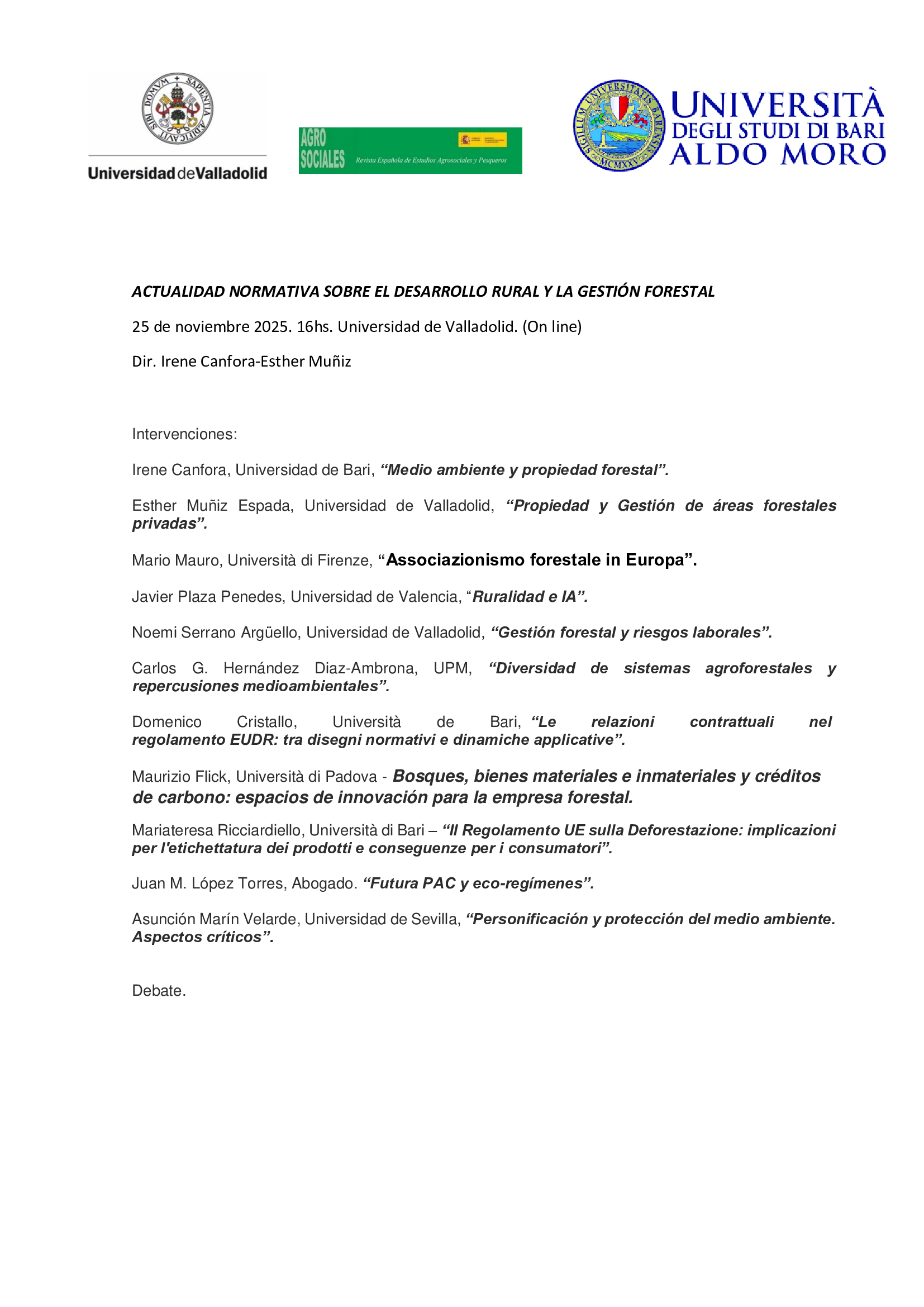
Conference “Current Legal Framework on Rural Development and Forest Management” held on November 25, 2025.
Summary
Spain is the second country in the European Union with the largest forest area—a fact significant enough to warrant an in-depth analysis of forest legal regulation, given the lack of correlation between its importance and the sector’s low profitability. In recent years, Spain’s forest area has increased as a result of European policies incentivizing the reforestation of agricultural land, which over time poses greater challenges and management difficulties. This trend exacerbates the main issue affecting forest areas: their high fragmentation and small-scale plots, which, due to their limited size, cannot be managed sustainably on an individual basis. This hinders efficient service provision and prevents the expansion of forests managed under formal forest management instruments.
For this reason, the conference reflected on legal measures that could reverse this situation. In this regard, the recent approval of the draft law on “Montes de socios” (Shared Forests) deserves review to include alternative legal approaches to their management, promoting legal personality models and various corporate structures. The aim is to adopt more agile and effective legal forms that ensure recognition of property rights and facilitate the regularization of registrations in the Land Registry.
On November 25, 2025, the University of Valladolid hosted the international conference “Current Legal Framework on Rural Development and Forest Management”, directed by Irene Canfora and Esther Muñiz, bringing together experts from Spain and Italy to discuss regulatory challenges, sustainability, and innovation in rural and forest sectors.
Key contributions:
- Irene Canfora (University of Bari): Examined the relationship between the environment and forest property, emphasizing the need to harmonize environmental protection with property rights.
- Esther Muñiz Espada (University of Valladolid): Highlighted the importance of legal instruments for the sustainable management of private forest areas.
- Javier Plaza Penadés (University of Valencia): Presented the impact of the EU AI Regulation on rural areas, addressing prohibited practices and compliance models for high-risk AI systems.
- Mario Mauro (University of Florence): Introduced forest agreements as a solution to property fragmentation in Italy, proposing cooperation networks to improve sustainable management.
- Carlos G. Hernández Díaz-Ambrona (Polytechnic University of Madrid): Analyzed agroforestry systems and their typologies, stressing the need for specific regulation and the impact of EU Regulation 2023/1115 on products linked to deforestation.
- Noemí Serrano Argüello (University of Valladolid): Reflected on the high accident rate in forestry work and the need to strengthen occupational risk prevention.
- Asunción Marín Velarde (University of Seville): Criticized the legal personification of nature, proposing more effective measures such as strict environmental regulation and sustainable incentives.
- Mariateresa Ricciardiello (University of Bari): Explained how the EU Deforestation Regulation affects the legal position of consumers, promoting responsible purchasing decisions.
- Domenico Cristallo (University of Bari): Examined the impact of the EUDR Regulation on contractual relationships in agri-food supply chains, warning of potential asymmetries for small producers.
- Maurizio Flick (University of Padua): Presented forests as spaces for business innovation linked to carbon credits.
- Juan M. López Torres (Lawyer): Addressed the future CAP and eco-schemes, analyzing the draft Regulation and the proposed Multiannual Financial Framework for the CAP 2028–2034.
The conference concluded with a debate on legal strategies to overcome forest fragmentation and advance toward sustainable and profitable management.